The Architecture of Solitude
Each cell at Shalban Vihara provided just enough space for sleep, meditation, and the careful copying of manuscripts. The monk's body, mind, and tools were ordered within a single contemplative chamber.
The Buddhist Legacy
For nearly a thousand years — from the 5th to the 13th century CE — the Bengal delta was one of the most active centres of organised Buddhism anywhere in the world. The wealth of its riverine economies, the openness of its ports to maritime trade with Southeast Asia, and the enlightened patronage of its rulers combined to produce a uniquely sophisticated Buddhist culture.
It was a tradition shaped by water as much as by stone — by the constant movement of monks, manuscripts, and ideas along the Ganges, the Brahmaputra, and the Meghna. Within this network, Shalban Vihara stood as one of the southern anchors: an inland monastic university connected through inland and maritime routes to the wider eastern Buddhist world.
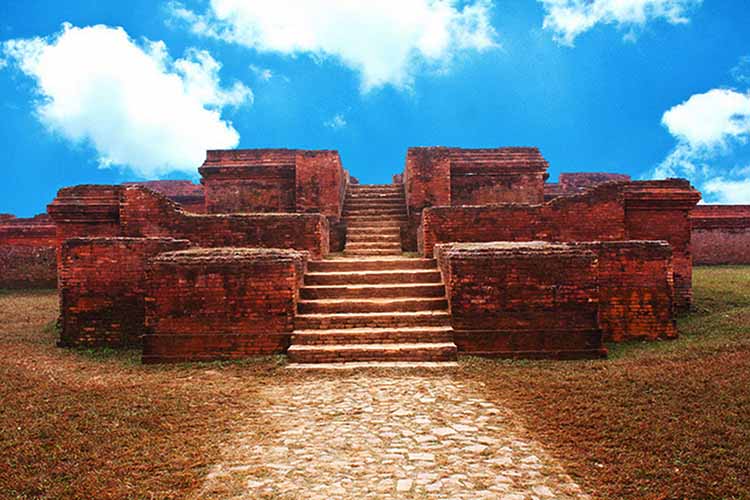
Across early-medieval South Asia, the vihara was not simply a residence for monks — it was a precisely engineered learning environment, a built form designed to enable a specific intellectual life.
Each cell at Shalban Vihara provided just enough space for sleep, meditation, and the careful copying of manuscripts. The monk's body, mind, and tools were ordered within a single contemplative chamber.
Cells opened inward toward a vast central courtyard — a gathering place for daily rituals, debate, and instruction, and the symbolic heart of the monastic body.
At the centre stood the shrine — the Buddha's presence rendered in brick and bronze. Every cell, every walkway, every rhythm of the day was oriented toward this contemplative axis.
A monk's life at Shalban Vihara was governed by an elegant economy of time. The pre-dawn hours were given to meditation; the morning to communal recitation of the Vinaya and study of foundational treatises; midday to the alms meal taken in silence; afternoons to teaching, debate, and the preparation of texts; evenings to chanting and contemplative practice.
The cells, the corridors, and the courtyard each played their structural role in this rhythm — together they constituted not a passive backdrop but an active instrument of monastic formation.
Disciplines taught here included Vinaya (monastic conduct), Abhidharma (philosophical psychology), Madhyamaka and Yogācāra (doctrinal philosophy), and increasingly, in the later centuries, the ritual and meditational systems of Vajrayāna Buddhism.
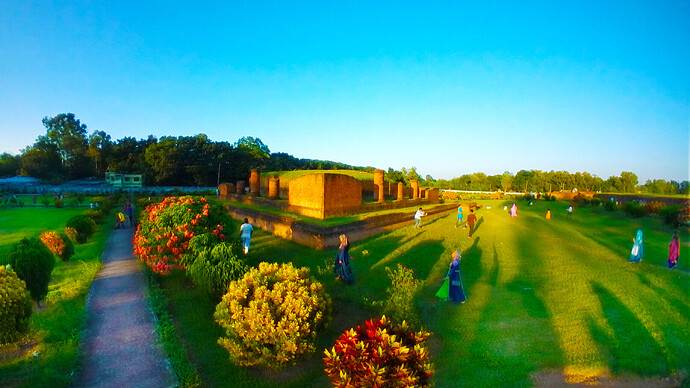
At its peak, the vihara is estimated to have housed over a hundred ordained monks of varying seniority — preceptors, instructors, and novices — each bound to the others by the discipline of the Vinaya and the daily rhythm of communal practice.
Monks from Nalanda, Vikramashila, Somapura, and the further Buddhist worlds of Tibet and Sri Lanka visited Shalban Vihara — drawn by the resident teachers, the manuscript collection, and the iconographic workshops.
Around the monastic complex was a wider lay world — patrons, artisans, scribes, traders, and farmers — who sustained the institution materially and were sustained by it spiritually through teaching, ritual, and pilgrimage.
Inscriptions name kings of the Deva and Chandra dynasties as benefactors. Their copper-plate grants funded the buildings, the ritual life, the manuscript libraries, and the icon workshops of the monastery.
Beyond its scholarly and architectural significance, Shalban Vihara was — and remains — a place of profound spiritual resonance. Within its precincts, devotional practice was carried on for nearly six centuries: chants and offerings, the consecration of icons, ordinations and renewals of vow, and the long, quiet labour of meditation.
Pilgrims from across Bengal and the wider eastern subcontinent travelled here to circumambulate the central shrine, to offer flowers and lamps, and to receive teachings from the resident community. The site preserves, even now, the silent residue of those generations of devotion.

Like much of early-medieval Bengal, Shalban Vihara hosted the meeting of multiple Buddhist streams — each leaving its imprint on the architecture, iconography, and intellectual life of the monastery.
The Vinaya — the disciplinary core common to all Buddhist schools — provided the basic framework of monastic life at the vihara, governing ordination, daily conduct, and ritual practice.
Mahāyāna doctrine — the cultivation of universal compassion and the bodhisattva ideal — shaped the iconography of the site. Bronze and stone images of Avalokiteśvara, Tārā, and Maitreya bear witness to the Mahāyāna devotional life of the community.
By the 9th–11th centuries, Vajrayāna ritual and meditation traditions — meditational deities, mandalas, and subtle-body practices — were fully integrated into monastic life, in close conversation with the great Pala monasteries of Bihar.
The deepest legacy of Shalban Vihara is not architectural but ethical. For nearly six centuries, this monastery upheld a coherent vision of human life — one organised around peace, disciplined inquiry, and the patient cultivation of wisdom.
That vision shaped not only the monks who lived here but the wider society that supported them: a culture of learning, dialogue, and contemplative practice that infused village, court, and trade route alike.
To preserve and study Shalban Vihara today is to recover access to that inheritance — and to invite the contemporary world to recognise, in these silent bricks, the durable architecture of a more reflective civilisation.
View Architectural Plan